
On-page SEO forms the bedrock of any successful content strategy, directly influencing how search engines like Google interpret and rank your pages. It encompasses optimizing elements such as titles, content, and structured data right on your site to align with user intent and algorithmic preferences. Yet, many website owners fall into common pitfalls that undermine visibility, from keyword stuffing to ignoring Core Web Vitals. These errors not only dilute rankings but also miss opportunities in AEO for voice search snippets and GEO through entity recognition via schema markup. As Google’s Helpful Content Update prioritizes E-E-A-T—Experience, Expertise, Authoritativeness, Trustworthiness—mastering on-page SEO becomes essential for topical clusters and knowledge graph integration. This post explores eight frequent mistakes, their impacts, and actionable fixes to elevate your site’s performance and secure rich results.
Keyword Stuffing in On-Page SEO Content
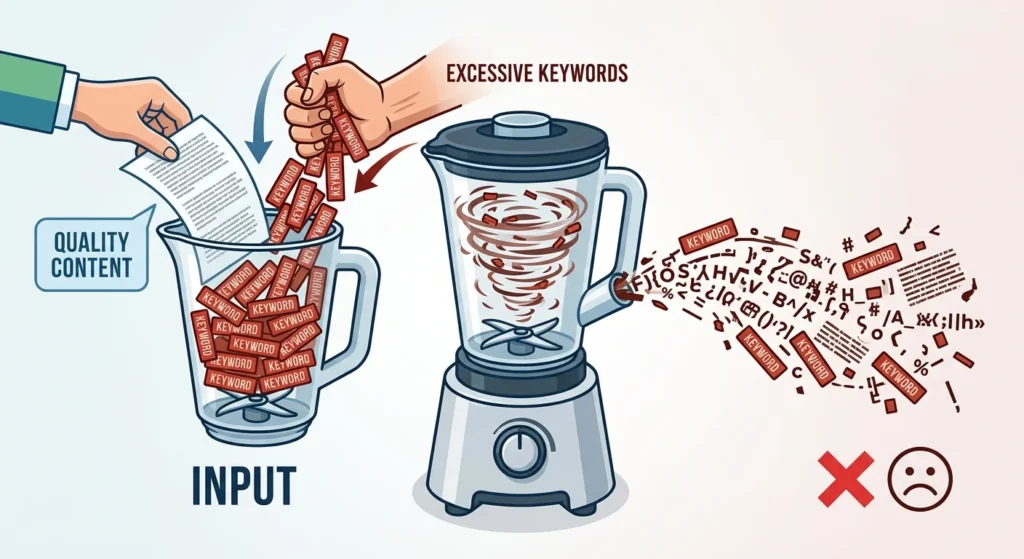
Keyword stuffing plagues on-page SEO by cramming unnatural repetitions of terms, which search engines penalize under spam guidelines. This practice harms semantic relevance, confusing algorithms trained on natural language processing and diminishing E-E-A-T signals. In AEO contexts, stuffed content fails to deliver concise answers for featured snippets or voice responses, eroding topical authority. Instead of building topical clusters around LSI terms like “search intent alignment” or “content freshness,” it fragments user trust and invites manual actions. GEO suffers too, as over-optimized text obscures entities for knowledge graph placement. Focus on user-first writing to avoid these setbacks.
- Prioritize semantic variations and LSI keywords naturally within context.
- Aim for 0.5-1.5% density using tools like Google Search Console.
- Structure content around user queries for AEO snippet eligibility.
- Incorporate related entities to strengthen knowledge graph ties.
- Audit existing pages with plagiarism checkers for over-optimization.
- Rewrite with active voice emphasizing expertise and value.
- Test readability scores above 60 on Flesch-Kincaid scales.
Neglecting Meta Tags for On-Page SEO
Overlooking meta tags cripples on-page SEO by slashing click-through rates (CTR) from search engine results pages (SERPs). Title tags and meta descriptions serve as previews, yet generic or absent ones fail to entice clicks, signaling low relevance to crawlers. This weakens GEO efforts, as unoptimized tags miss entity signals for structured data interpretation. In Google’s ecosystem, compelling metas boost impressions while aligning with Helpful Content Update rewards for helpful previews. Poor tags also hinder AEO, where precise summaries win zero-click answers. Elevate CTR to capture traffic in competitive niches.
- Craft title tags under 60 characters with primary keywords upfront.
- Write meta descriptions of 150-160 characters highlighting unique value.
- Include LSI terms and calls-to-action for higher engagement.
- Use brand entities consistently for GEO knowledge graph boosts.
- Validate with Google’s Rich Results Test for preview accuracy.
- A/B test variations via Search Console performance reports.
- Avoid truncation by prioritizing front-loaded key phrases.
Poor Internal Linking in On-Page SEO
Weak internal linking fractures authority flow in on-page SEO, preventing crawlers from distributing PageRank efficiently across your site. Without strategic anchors, pages remain siloed, weakening topical clusters and E-E-A-T demonstrations. This scatters user navigation, increasing bounce rates and harming dwell time metrics. For AEO, fragmented links miss pathways to supporting content that answers complex queries. GEO integration falters as entities lack contextual reinforcement through linked hubs. Build a cohesive architecture to amplify signals.
- Anchor text with descriptive, keyword-rich phrases naturally.
- Link to 3-5 related pages per 1000 words for balanced density.
- Create hub-and-spoke models for topical authority.
- Use tools like Ahrefs to map and optimize link equity.
- Implement breadcrumbs for enhanced crawlability and UX.
- Refresh orphan pages by adding inbound links from pillars.
- Monitor link health quarterly to prune broken references.
Ignoring Image Optimization in On-Page SEO
Skipping image optimization in on-page SEO tanks Core Web Vitals, especially Largest Contentful Paint (LCP), leading to ranking demotions. Uncompressed visuals bloat load times, frustrating mobile users and crawlers assessing page experience. This oversight ignores GEO potential, as alt text and filenames clarify entities for image search and knowledge graph. AEO suffers without optimized visuals for visual snippets. Compress and contextualize media to reclaim speed and visibility.
- Compress images to under 100KB using WebP format.
- Add descriptive alt text with LSI keywords and entities.
- Name files semantically, like “on-page-seo-core-vitals-guide.jpg”.
- Implement lazy loading for below-the-fold assets.
- Leverage responsive images via srcset attributes.
- Test LCP scores under 2.5 seconds with PageSpeed Insights.
- Embed schema markup for image objects where relevant.
Duplicate Content Hurting On-Page SEO
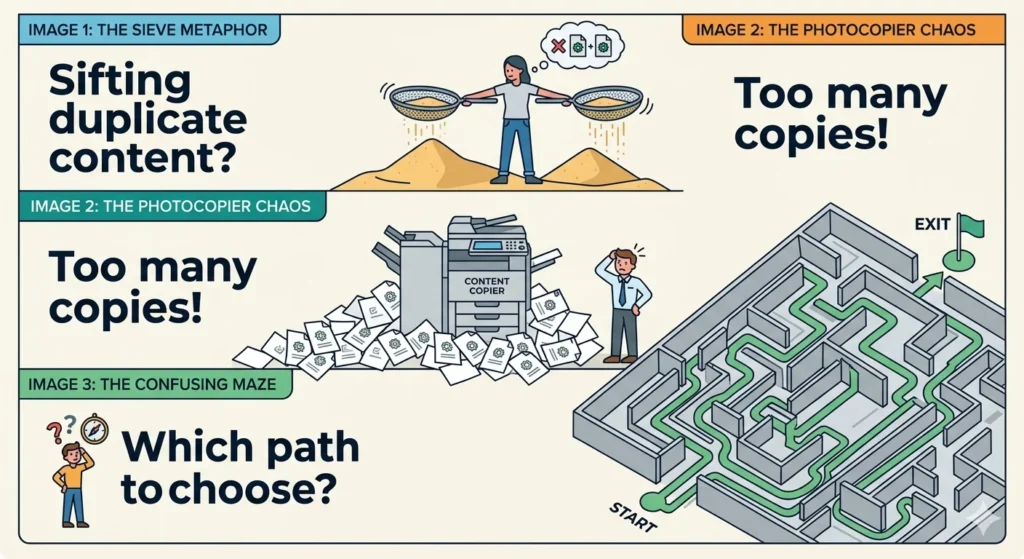
Duplicate content sabotages on-page SEO by triggering cannibalization and penalty risks from Google’s duplicate detection. Identical pages confuse crawlers on canonical signals, diluting authority and E-E-A-T across your domain. This disrupts topical clusters, as repeated material fails to add unique value per Helpful Content Update. AEO opportunities vanish without fresh angles for answer engines, while GEO entities blur in redundancy. Consolidate to sharpen focus.
- Deploy canonical tags on near-duplicates pointing to primaries.
- Use 301 redirects for exact matches to consolidate equity.
- Rewrite variations with unique insights and LSI expansions.
- Enable Search Console parameters to block thin duplicates.
- Audit site-wide with tools like Screaming Frog.
- Employ noindex on paginated or filtered duplicates.
- Refresh old content to ensure topical freshness signals.
Overlooking Mobile and Speed in On-Page SEO
Neglecting mobile responsiveness and speed in on-page SEO causes indexing failures, as Google defaults to mobile-first crawling. Slow sites violate Core Web Vitals thresholds, slashing rankings amid page experience emphasis. This hampers AEO for voice queries on mobile devices and GEO through poor entity rendering on small screens. Users abandon laggy pages, spiking bounce rates. Prioritize responsiveness for sustained traffic.
- Adopt responsive design with fluid grids and media queries.
- Minify CSS, JS, and HTML to reduce payload.
- Enable browser caching and GZIP compression.
- Optimize server response times below 200ms.
- Use AMP for news/content if targeting snippets.
- Run mobile-friendly tests via Google’s Mobile Usability tool.
- Benchmark Core Web Vitals in Search Console dashboards.
Missing Header Structure for On-Page SEO
Absent or illogical header structures bewilder crawlers in on-page SEO, obscuring content hierarchy and semantic meaning. Without proper H1-H6 tags, algorithms struggle to parse topics, weakening topical authority and LSI integration. This confuses AEO parsers seeking structured answers and hinders GEO entity hierarchies. Clear headers guide users and bots alike for better comprehension.
- Limit to one H1 per page matching primary focus.
- Sequence H2 for main sections, H3 for subsections.
- Infuse LSI terms naturally in header phrasing.
- Ensure logical flow mirroring user scan patterns.
- Validate hierarchy with tools like Merkle’s SEO Extension.
- Bold key phrases sparingly within headers.
- Align headers with schema markup for rich context.
Underutilizing Schema Markup in On-Page SEO
Failing to implement schema markup in on-page SEO forfeits rich results like carousels and knowledge panels, limiting SERP real estate. This gap weakens GEO by under-signaling entities to Google’s knowledge graph and stifles AEO for enhanced snippets. Despite E-E-A-T rewards for structured expertise, most sites overlook JSON-LD for FAQs or articles. Harness it to dominate visibility.
- Identify relevant schemas via schema.org for your niche.
- Embed JSON-LD scripts in head or body sections.
- Validate with Google’s Structured Data Testing Tool.
- Target Article, FAQPage, or HowTo for AEO wins.
- Link entities to Wikidata for GEO authority.
- Monitor rich result performance in Search Console.
- Expand topical clusters with interconnected markup.
Conclusion
Mastering on-page SEO demands vigilance against these pitfalls—from keyword stuffing and meta neglect to schema underuse—while embracing Core Web Vitals, E-E-A-T, and integrations with AEO and GEO. Fixing them fortifies topical authority, snippet wins, and knowledge graph presence amid Google’s evolving updates. As a digital marketer, audit your site today using free tools like Search Console to implement these strategies and track gains. Start with one section, measure CTR and rankings, then scale. Ready to boost your visibility?